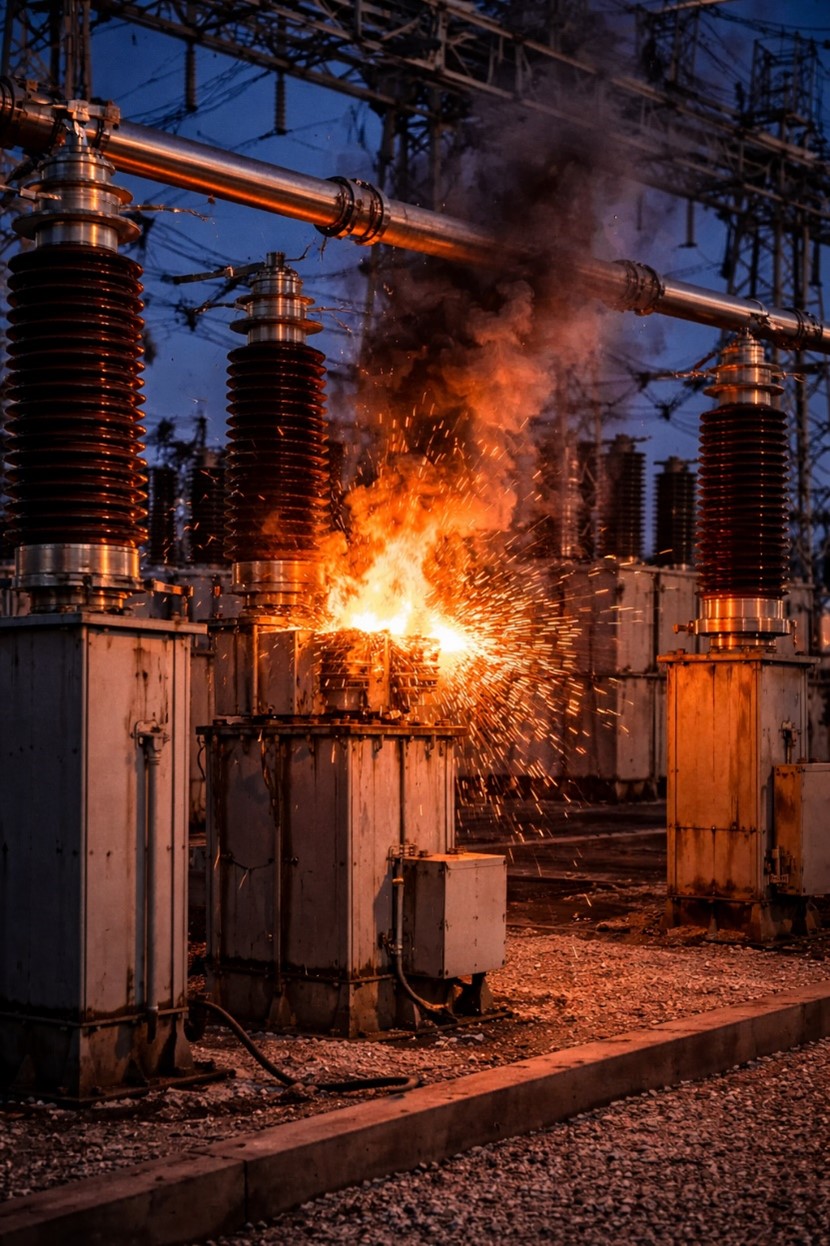
As electrical infrastructure expands to support electrification, renewable generation, hyperscale data centers, and long-distance transmission, systems are operating at higher loads and tighter safety margins.
In substations, powerlines, switchgear, and HVDC converter stations, major failures rarely begin as dramatic events. They typically start with localized electrical stress — corona partial discharge (PD) developing at insulators, conductors, bushings, connectors, hardware or contaminated surfaces.
These early-stage discharges may not produce visible damage, audible noise, or measurable heat. Yet they represent the first step in a degradation process that can progress toward arcing, insulation breakdown, and forced outages.
Effective safety management therefore depends on identifying deterioration before escalation occurs.
Understanding the Escalation Mechanism
Electrical degradation often follows a predictable sequence:
- Mechanical or electrical defects, improper component installation, or surface contamination
- Corona partial discharge activity
- Progressive insulation degradation due to PD
- Arcing or flashover
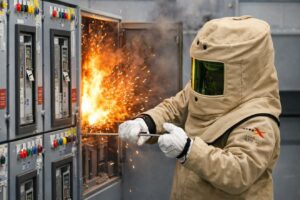
Once arcing develops – the event can escalate within milliseconds. Consequences may include severe equipment damage, personnel injury, secondary fire, and extended downtime.
From a safety standpoint, the key variable is not reaction speed. It is early detection.
Rethinking Safety: Non-Destructive and Non-Intrusive Testing
In operational power systems, safety-oriented diagnostics aim to evaluate equipment condition without creating additional risk. Two related, but distinct, concepts are important in this context: non-destructive and non-intrusive.
Non-destructive testing refers to methods that assess equipment condition without causing physical damage or accelerating degradation. The asset remains intact and operational after the inspection.
However, a method can be non-destructive while still being intrusive.
Intrusive diagnostics may require:
- Physical connection to the asset
- Installation of temporary sensors or coupling devices
- Access inside restricted or arc-flash boundaries
- Close proximity to energized components
For example, certain partial discharge measurement systems provide highly detailed electrical data but may require sensor installation or direct coupling to the equipment under test. While these techniques do not damage the asset, they involve interaction with energized infrastructure.
By contrast, a non-intrusive method requires no physical contact, no electrical connection, and no modification of the system during inspection.
Solar-blind UV corona imaging meets both criteria:
- It is non-destructive, as it introduces no stress and does not affect insulation systems.
- It is non-intrusive, as it operates purely optically — without contact, grounding, signal injection, or conductive coupling.
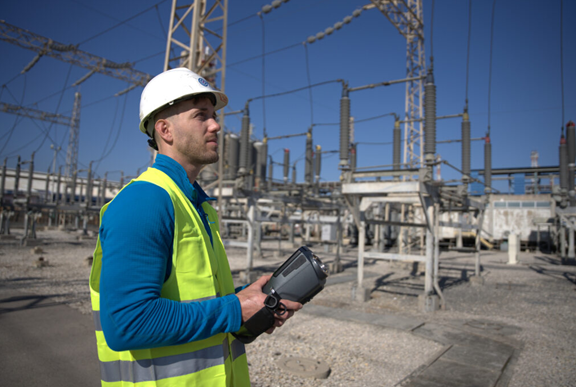
Inspection can be performed from a distance, while the system remains energized and undisturbed.
In high-voltage environments, this dual characteristic — non-destructive and non-intrusive — directly supports risk reduction by minimizing both system disturbance and personnel exposure.
Why Early Corona PD Detection Is a Safety Issue
Corona discharge is not yet a failure — but it is a warning.
At the corona PD stage, corrective action can be scheduled under controlled conditions. Equipment can be cleaned, adjusted, or replaced before insulation integrity is compromised.
If partial discharge continues unchecked, insulation surfaces degrade. In enclosed environments such as switchgear, the transition from discharge to internal arcing can occur extremely rapidly.
From a safety standpoint, the objective is not simply to detect faults.
It is to detect them before personnel are exposed to the conditions that precede arc flash or flashover.
Early detection reduces:
- The probability of arc flash events
- Emergency intervention under energized conditions
- Exposure to unstable or deteriorating equipment
- Unplanned work inside restricted zones
Safety improves when degradation is addressed before it becomes unstable.
Exposure Reduction in Practical Environments
Substations and Switchgear
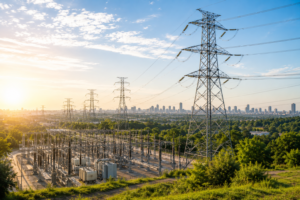
In substations, corona PD may develop at insulators, connectors, bushings, or conductors.
Traditional diagnostic approaches may require opening panels, installing sensors, or working within arc-flash boundaries.
Remote UV inspection allows evaluation of energized components without physical interaction. No panels are opened. No coupling devices are installed. No direct contact is made.
This reduces:
- Time spent inside restricted areas
- Handling of energized components
- The probability of unintended disturbance
In medium- and high-voltage switchgear environments, where arc flash risk is significant, minimizing physical interaction directly reduces personnel exposure.
Transmission and Distribution Lines
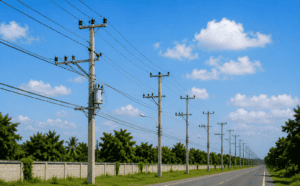
On overhead lines, corona PD may occur due to hardware damage, improper installation, or surface contamination.
Ground-based or UAV-based UV inspection enables detection from offset distances, without climbing structures or installing temporary measurement equipment.
Reducing proximity reduces risk.
HVDC Converter Stations
HVDC systems operate under sustained high electric field intensity. Continuous DC stress can accelerate insulation degradation and surface tracking.
In these environments, proximity itself represents a hazard.
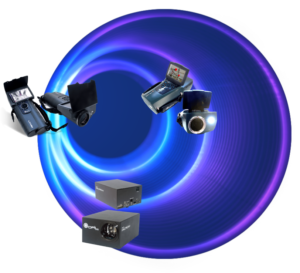
Distance-based optical inspection allows energized components to be evaluated without entering high-field areas or modifying the system configuration. In addition to handheld or ground-based inspection, UV cameras can be deployed on robotic platforms or installed as fixed monitoring systems within valve halls or DC yards.
Robotic inspection enables remote operation in areas where human access may be restricted or undesirable. Fixed installations provide continuous monitoring without requiring personnel presence in high-field zones.
In HVDC yards and converter halls, reducing physical interaction is not simply a matter of efficiency – it is a structured safety measure that lowers exposure and limits the need for repeated entry into energized environments.
Conclusion
Electrical safety depends on two principles:
- Detect deterioration before escalation
- Minimize exposure during inspection
Inspection strategy influences both.
When degradation is identified early, unstable conditions can be corrected before arcing develops. When inspection does not require contact or close proximity, personnel exposure is reduced.
Diagnostics that are both non-destructive and non-intrusive support these objectives directly.
Solar-blind UV imaging enables early detection of corona PD while the system remains energized and undisturbed, without physical interaction and without increasing risk.
In high-voltage environments, the safest inspection is not only the one performed early.
It is the one performed without touching the system at all.