From the first prototype to decades of service, partial discharge (PD) can silently threaten the health of any rotating machine whether it’s a low-voltage 200V EV motor, a medium-voltage 6.6 kV industrial drive, or a high-voltage 13.8 kV generator. Detecting and locating PD early is key to ensuring reliability, safety, and performance.
Solar-blind UV imaging provides an unparalleled view into this hidden world, making the invisible visible at every stage of your machine’s life cycle.

1. Design Optimization: Build Reliability from the Start
During prototype and design validation, UV cameras visualize external partial discharges under high-voltage stress.
By capturing real-time corona activity and insulation weak spots, engineers can:
- Validate insulation design and material selection.
- Detect localized stress points before costly tooling or certification.
- Optimize the geometry and layout of windings, terminals, and clearances.
This early-stage visibility allows manufacturers to perfect insulation systems before the product reaches production — preventing future breakdowns.
2. Manufacturing & Quality Assurance: Ship with Confidence
In manufacturing, UV imaging is often incorporated as a fast, non-contact verification step alongside standard insulation quality tests such as hipot, surge tests, Partial Discharge Inception Voltage (PDIV), Repetitive Partial Discharge Inception Voltage (RPDIV), and AC withstand testing. This additional visual layer helps confirm that no surface or corona discharges are present on completed assemblies, providing a more complete assessment of insulation integrity. By combining UV inspection with electrical tests, manufacturers can identify early-stage insulation stress or discharge activity that might not appear through other measurements.
This additional visual layer:
- Confirms insulation integrity before shipment.
- Catches issues often missed by conventional electrical tests.
- Enhances quality assurance and customer confidence.
Every PD-free machine that leaves the production line is a step toward long-term reliability and reduced warranty claims — fully aligned with best practices and standards such as IEEE 1799 & IEEE 1434 for Partial Discharge Testing in Rotating Machines.

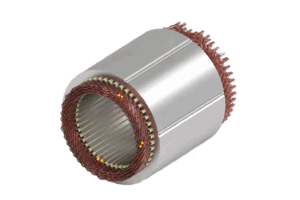
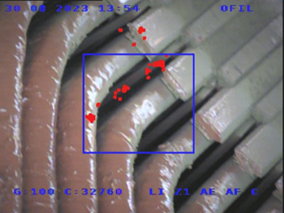
Example of PD detection on a stator using UV camera
3. Commissioning: Establish a Healthy Baseline
Once the machine is installed, UV inspection validates its condition during energization.
Installation errors, transport damage, or contamination can all introduce weak points that lead to early PD.
Performing UV inspection during commissioning:
- Detects discharge sources before the asset enters service.
- Ensure proper installation and cleanliness.
- Establishes a baseline for future comparison and trending.
This baseline becomes an invaluable reference for maintenance teams over the life of the equipment.
4. Periodic Maintenance: Stay Ahead of Failure
Condition-based maintenance programs rely on consistent, comparable data.
Routine UV inspections during scheduled outages help identify developing PD activity long before it becomes critical.
With periodic monitoring, operators can:
- Track PD progression and trend severity.
- Plan repairs proactively, avoiding unplanned shutdowns.
- Optimize maintenance schedules based on asset condition.
This approach is particularly beneficial in high-value assets such as industrial drives, power-plant generators where downtime carries a heavy price.

Example of PD detection on a stator during periodic maintenance.
5. Repair & Refurbishment: Verify Restoration Quality
When a failure occurs, UV imaging is a powerful troubleshooting tool.
It precisely locates discharge sites, such as deteriorated end windings, defects in insulation, or contamination.
After repairs are complete, the same camera confirms that the discharge has been eliminated:
- Verifies repair effectiveness.
- Ensures PD-free operation before return to service.
- Reduces the risk of repeat failures.
The result: a validated, reliable restoration backed by visible proof.

Example of PD activity in the end winding

Example of PD activity on a single coil
A Clear View of Reliability
Whether you design, build, operate, or repair rotating machines, integrating UV inspection across the asset life cycle ensures continuous reliability.
From prototype validation to in-service maintenance, UV imaging provides the clearest path to PD-free performance – empowering your team to see what others can’t and act before failures occur.