Your Critical Substation, Watched Around the Clock
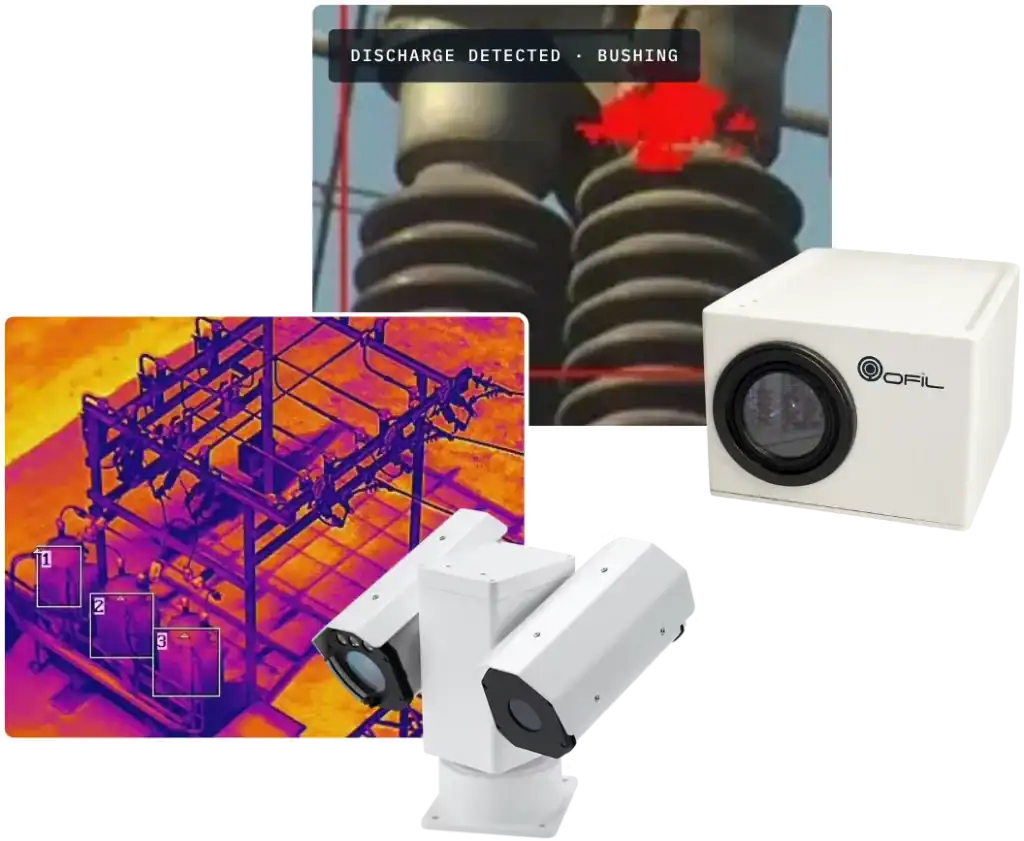
OFIL's solar blind DayCor® UV cameras and moviTHERM's thermal monitoring platform watch your high voltage assets 24/7, and alert your team when discharge activity or heat passes the alarm limits you set.
Built for sites that cannot easily shut down to inspect, and have no one spare to stand and watch the yard.
UV detection by OFIL · Thermal monitoring platform by moviTHERM


Between inspections
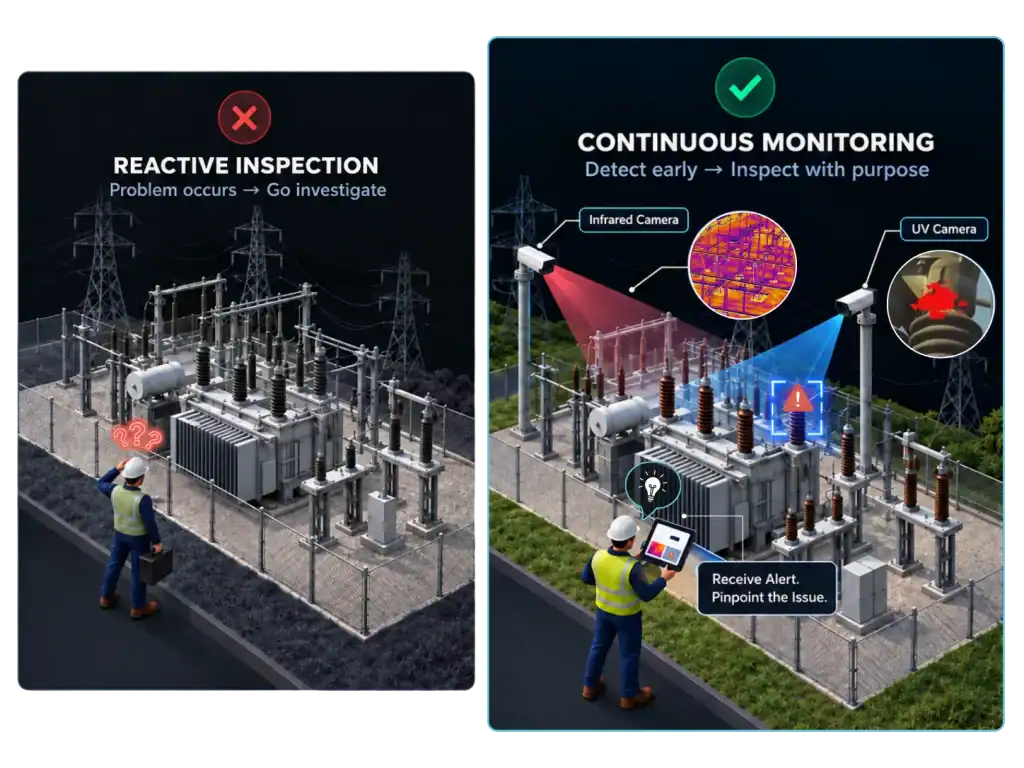
Faults Don't Wait for Your Next Inspection
Thermal readings depend on the load, wind and sun at the moment of an inspection, and humidity changes how strongly corona shows. One scheduled visit captures one moment. Early detection gives your team time to act before a developing fault turns into a costly, disruptive outage.
- Discharge trends tracked over time, not only on inspection day
- Alarms based on limits your team sets
- Time to plan the repair instead of reacting to a failure
UV + thermal
Two Failure Mechanisms. One System Watching Both.
UV and thermal cameras detect different failure mechanisms. UV shows discharge driven by voltage stress, thermal shows heat driven by current flow. Neither replaces the other, and either one may be the first sign of a developing fault. Together they give your team a fuller view of how a defect develops.
“Thermal and UV technologies address different points on the same failure timeline.”
OFIL, announcing the moviTHERM partnership, April 2026
Discharge driven by voltage stress
- Corona and partial discharge
- Corona caused by contamination such as salt, dust or industrial pollution
- Visible with or without load
- Solar blind, so it works in full daylight
Heat driven by current flow
- Hot spots at loose or degraded connections
- Overloaded components
- Phase imbalance
The physical picture
- HD visible video for clear visual confirmation of faults
- Cracked insulators, missing hardware and corrosion
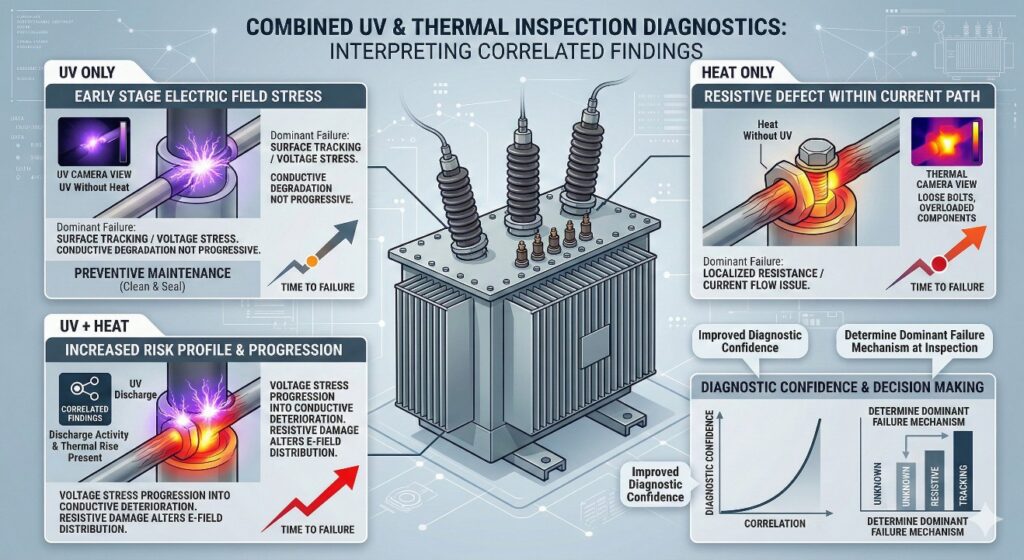
When both appear in one spot, the risk is higher
Discharge and heat at the same location can mean that voltage stress has progressed into conductive damage. Seeing both helps your team judge the risk and the failure mechanism at work.
Reading combined findings: UV only, heat only, and both at the same spot
The UV inside the system
Why the UV Comes From OFIL
DayCor® camera cores are built for fixed and PTZ mounted continuous monitoring of substations and high voltage components.
Solar blind by design
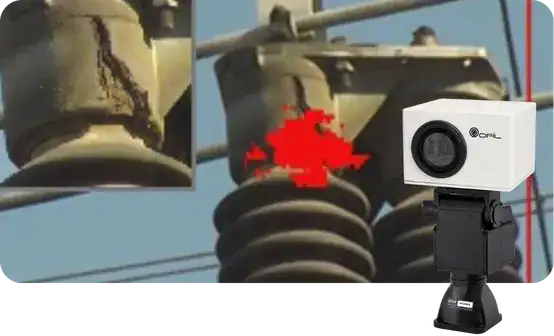
DayCor® cameras work in the UVC band, 240 to 280 nm, where the ozone layer absorbs solar radiation. Corona discharge stands out even in full daylight.
Certified sensitivity
UV Eye detects partial discharge down to 1 pC at 15 m, tested and certified by Eurotest Germany to IEC 60270:2000.
Made for unattended duty
Designed for long term, unattended operation outdoors: IP65, fanless, rated from −20 °C to +55 °C, with ONVIF, RTSP and API connectivity, adjustable UV alarm thresholds and pan and tilt compatibility.
Founded in 1993
OFIL makes solar blind DayCor® UV inspection systems for high voltage markets.
Long range camera core: 1 pC at 15 m, with powerful zoom for precise pinpointing.
Compact camera core with a wide 20° field of view: 1 pC at 8 m, 1.6 kg.
Compact, lightweight camera core: 1 pC at 15 m, 2.1 kg.
How it works
Always Watching. Your Team Decides.
01
Scan
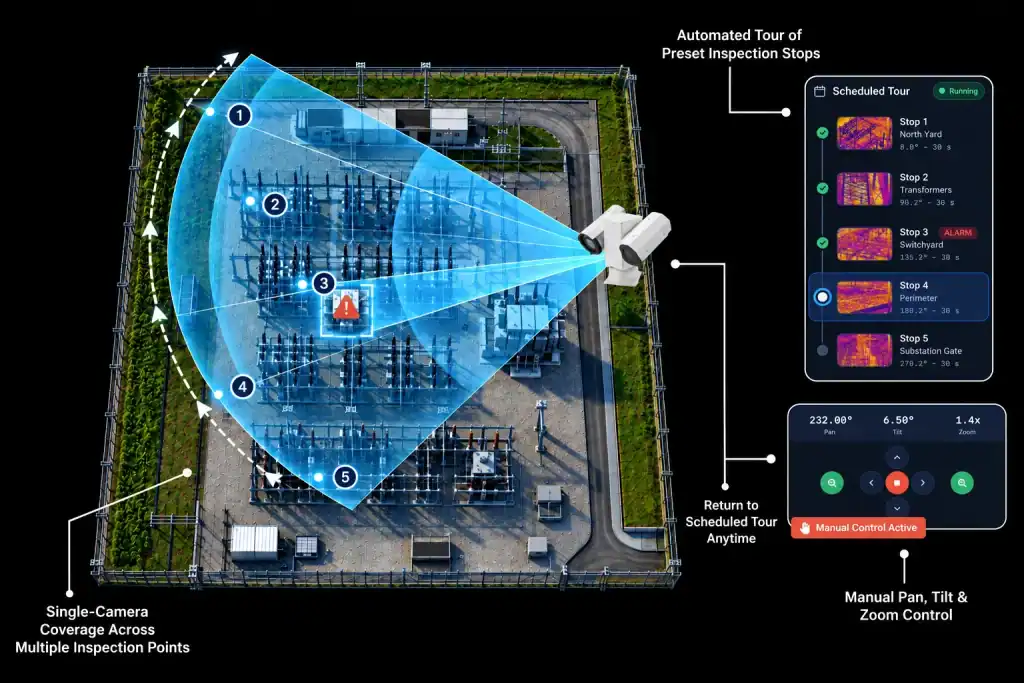
Fixed cameras stay on your most critical assets, and PTZ cameras scan transformer bushings, insulators, conductors and busbars along a preset route. Your team can take manual control at any time.
02
Compare
Readings are checked against the UV and temperature limits your team sets.
03
Alert
Crossing a limit triggers an alarm: a call, text or email to the people you choose, or a local response.
04
Act
Maintenance is planned from the severity of each recorded event.
- Monitoring 24/7
- PTZ routes and fixed views
- Alarm rules you define
- Alarm history and trends
- Secure PLC connection
- VMS integration over ONVIF and RTSP
Several cameras and sensors can be watched together on moviTHERM's iTL platform.
Need deeper analysis? Gridnostic, OFIL’s optional diagnostics software, adds EPRI based severity scoring.
Who it's for
For Sites Where an Outage Is Not an Option

Data centers and colocation
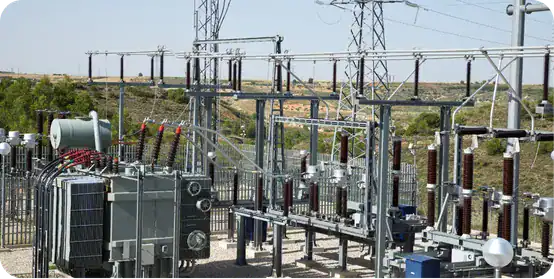
Uptime is the whole job, and inspecting switchgear can mean an outage window you cannot get. Keep the substation and MV gear that feed the campus under watch between maintenance windows. With long lead times for high voltage transformers, keeping existing units healthy matters.
Typical assets: MV switchgear, transformer bushings, cable terminations, busbars
Heavy industry with its own substation
Metals, mining, refining and semiconductor plants often depend on scheduled shutdowns or an outside crew to check their substations. With production on the line, continuous monitoring keeps watch while the plant runs.
Typical assets: switchgear, transformer bushings, insulators and busbars
Electric utilities
Watch critical substations around the clock through remote monitoring, which keeps people out of high risk areas.
Typical assets: transformer bushings, insulators, conductors and busbars
Field case
How a Global Cloud Provider Uses Fixed OFIL UV Monitoring
A global cloud and AI infrastructure provider added fixed OFIL UV monitoring units at the substations that power its high availability zones and GPU dense compute clusters, for 24/7 visibility of its most critical components.
- Instant alerts when abnormal discharge appears
- Automatic recording of events for root cause analysis
- Early detection of faults between scheduled inspections
- Long term trending of discharge behavior
- Monitoring through weather events, humidity changes and contamination buildup

“By integrating OFIL’s globally proven UV detection with intelligent thermal monitoring, we are giving utilities a comprehensive early warning system for the grid. At OFIL, our mission has always been to make the invisible visible, and through this integration, we are making it actionable.”
Giora Levi, CEO, OFIL Systems
OFIL's UV Technology Is Trusted by Global Leaders



Start With a Conversation About Your Site
Bring a site plan, or just a list of your critical assets. An OFIL specialist will talk it through with you:
- Which assets are the most critical to watch
- Whether UV, thermal or both fit the risks you face
- How fixed and PTZ cameras could cover your site
Frequently asked questions
What does UV see that thermal does not, and the other way around?
Corona and partial discharge give off UV light when voltage stress ionizes the air around a conductor or insulator, and a solar blind UV camera makes that light visible. A thermal camera measures the heat that current produces where resistance has grown, such as at a loose connection or an overloaded component. One follows voltage, the other follows current.
Should we monitor with UV, thermal or both?
It depends on your assets and risks. Neither technology replaces the other, and either one may be the first sign of a developing fault. Together they give a more complete view of asset condition, and an OFIL specialist can help you decide what fits your site.
What does continuous monitoring add to periodic inspections?
Readings change with load, humidity, wind and sun, so a single visit can miss what happens on other days. A monitoring system records events as they happen, tracks trends and raises an alarm when a limit is crossed, so developing problems surface between inspections.
Does UV monitoring work in daylight?
Yes. DayCor® cameras are solar blind: they work in the UVC band, 240 to 280 nm, where the ozone layer absorbs solar radiation, so corona discharge stays visible even in full sunlight.
When is a PTZ camera better than a fixed one?
Use PTZ to cover more ground: one camera steps through a set of saved positions. Use a fixed camera where one critical asset needs constant attention. Combining the two is common.
How does it fit with our VMS and PLC?
OFIL UV cameras stream over ONVIF and RTSP and can be controlled through an API, so they fit into video management systems. For control systems, moviTHERM’s platform can pass alarms to your PLC over a secure connection.
Who are OFIL and moviTHERM?
OFIL Systems, founded in 1993, makes solar blind DayCor® UV cameras that detect corona and partial discharge on high voltage equipment. moviTHERM, based in Irvine, California, specializes in thermal imaging and monitoring. Its iTL platform brings OFIL’s UV detection and thermal monitoring together in one system.