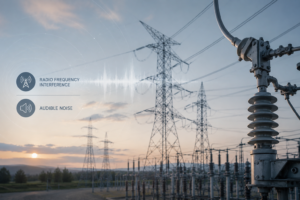
Electrification is pushing motor design into new territory. Higher voltage, faster switching, greater power density, and operation at altitude are improving performance – but they are also creating a smaller margin for insulation defects and partial discharge.
A hidden reliability challenge
Electric vehicles and electric aircraft are being designed to deliver more power from lighter, smaller, and more efficient systems. In EVs, the industry is increasingly moving from traditional 400 V architectures toward 800 V systems and beyond. At the same power level, higher voltage can reduce current, helping enable faster charging, lower electrical losses, improved thermal management, and potentially lighter cabling. It also supports the performance expected from the next generation of electric powertrains.
At the same time, motor designers are pursuing higher power density, more compact and intricate geometries, and new material strategies, including efforts to reduce dependence on rare-earth elements. These trends are valuable, but together they can increase electrical stress on the winding insulation. Partial discharge (PD) – a localized electrical breakdown that does not immediately bridge the insulation – can gradually erode that insulation and eventually contribute to premature failure.
Why PWM changes the testing environment
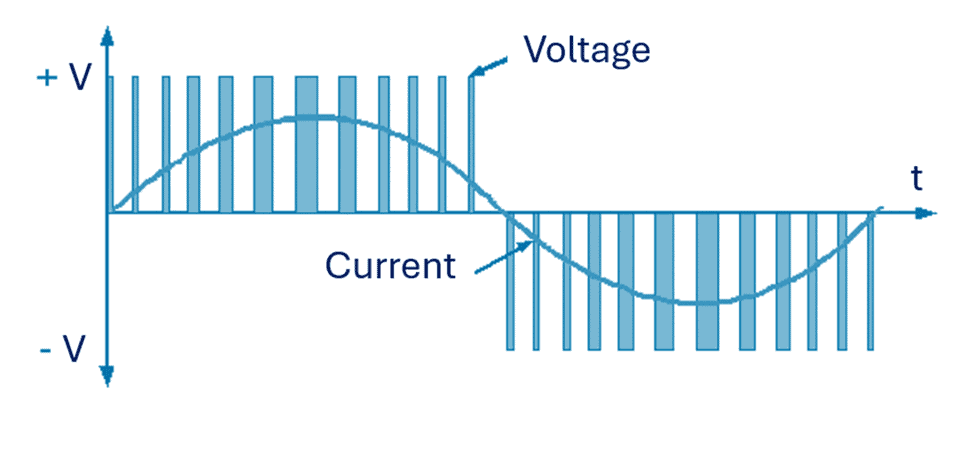
An EV motor is not supplied by a clean sinusoidal voltage. Its inverter rapidly switches the battery’s DC power to create the voltage waveform needed to control motor speed and torque. This pulse-width modulation (PWM) is essential for efficient operation, but its fast voltage transitions and steep rise times can produce uneven voltage distribution across the first turns of a winding and place concentrated stress on the insulation. As voltages and switching speeds rise, the challenge becomes more significant.
The same switching that stresses the insulation also complicates PD measurement. PWM inverters generate strong electrical noise around each switching event. These transients can be far larger than the PD pulses being measured, masking the signal, saturating sensors, or making it difficult to separate a real discharge from the inverter’s normal operation. In addition, PD under repetitive fast pulses does not necessarily behave the same way it does under conventional sinusoidal AC test voltage. A test approach based only on traditional AC conditions may therefore provide an incomplete picture of the stresses seen in service.
Electric aircraft: the additional challenge of altitude
Electric-aircraft propulsion brings the same pressure for higher voltage and power density, with even stricter requirements for weight, size, efficiency, and reliability. It also introduces an operating condition that road vehicles do not face: reduced air pressure at altitude.
According to Paschen’s Law, the voltage required for electrical breakdown in air depends on pressure and gap distance. As an aircraft climbs and pressure falls, the breakdown voltage for relevant air gaps can decrease substantially; under representative conditions at 10,000 feet, it may be roughly 40% lower than at sea level. An insulation system that appears PD-free during a ground test may therefore face a more demanding environment in flight. For aircraft motors, maintaining PD-free performance throughout the operating envelope is not only a lifetime consideration – it is central to safe, dependable propulsion.
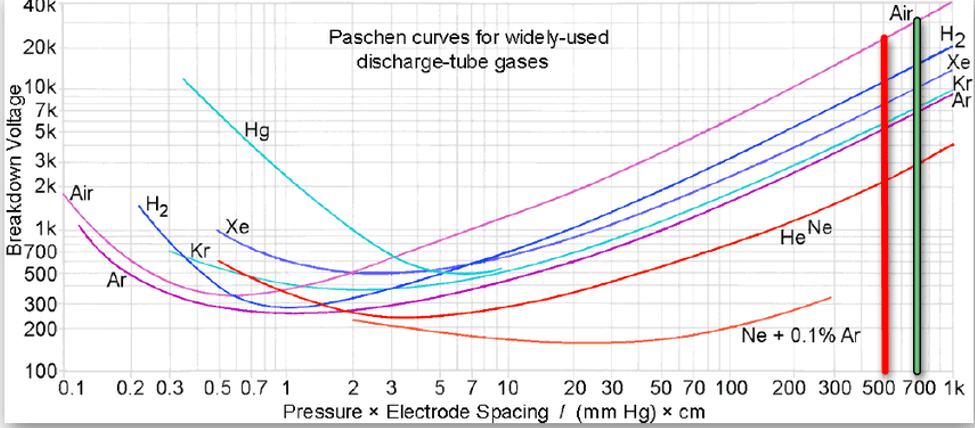
Paschen curves showing how air pressure and electrode spacing influence electrical breakdown voltage.
OFIL’s development focus
OFIL is advancing UV imaging methods for motor insulation development, validation, and fault investigation. The goal is to complement established electrical measurements with noise-immune visual evidence and practical localization of discharge activity. Recent work on motor stators illustrates this approach.
Adding Spatial Information to Partial Discharge Testing
Recent testing on motor stators demonstrates how UV imaging can complement conventional electrical partial discharge measurements by adding spatial information to the diagnostic process.
UV imaging was evaluated during AC, Surge, and RPDIV testing, with measurements repeated at different viewing angles, working distances, and voltage levels. During RPDIV testing, the electrical measurement system identified the presence and inception of partial discharge, while UV imaging provided a visual indication of where the discharge activity was occurring on the stator. The new UV imaging setup proved highly effective for both phase-to-ground and phase-to-phase inspections, clearly showing discharges from each individual phase.
Heatmap overlays enabled the detected UV activity to be mapped directly onto the stator. Repeated observations from different viewing positions showed discharge activity associated with the same physical area, demonstrating the potential of UV imaging to support repeatable localization of PD sources.
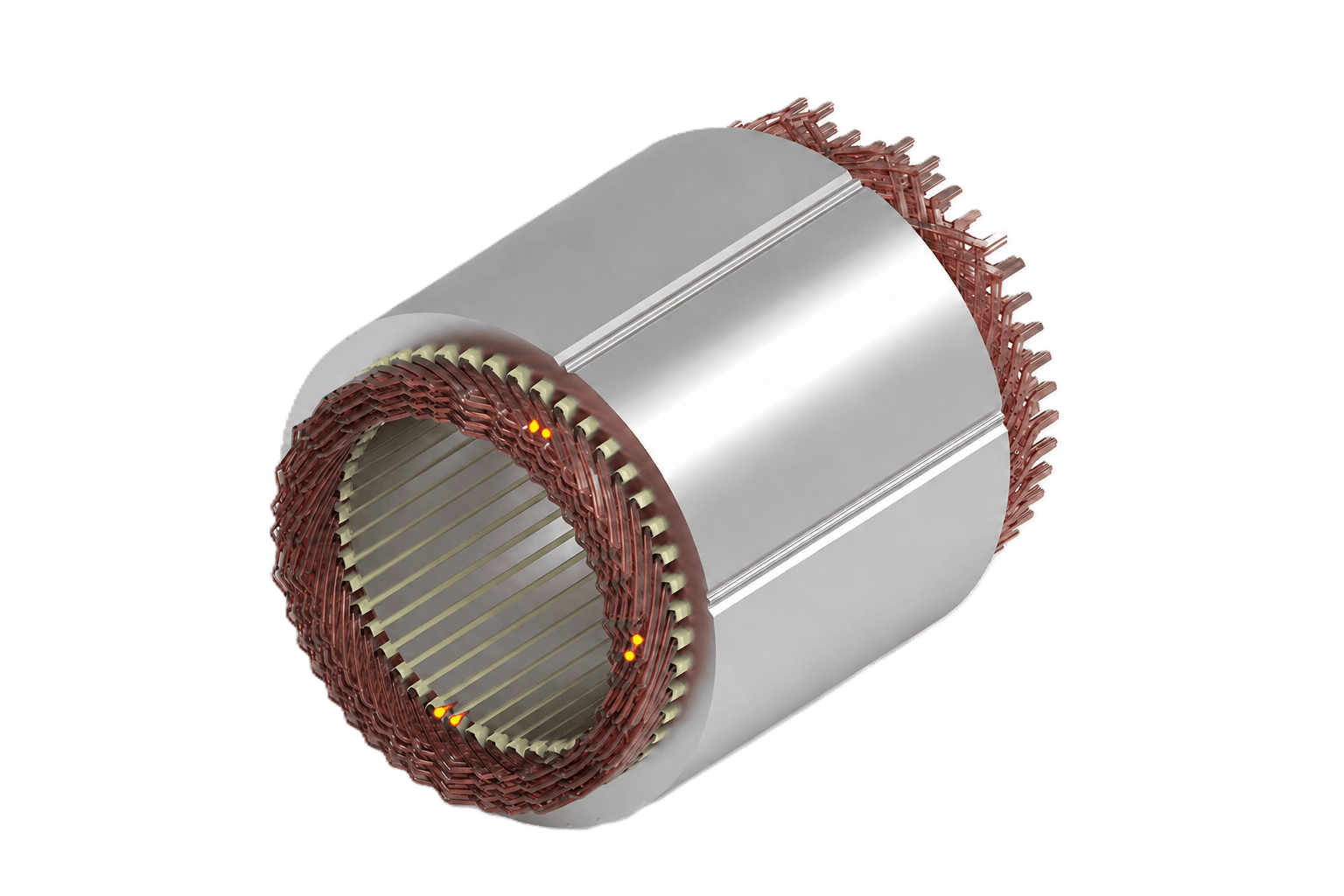
Illustration based on a 3D motor-stator model, showing how UV-detected partial discharge activity can be spatially mapped to specific locations on the stator windings and between stator-core slots.
This combination provides complementary diagnostic information: conventional electrical testing characterizes the presence and electrical behavior of PD, while UV imaging can help identify its physical origin. For motor manufacturers and service organizations, this additional spatial information can support faster fault investigation and more targeted inspection of stator insulation.
A more complete view of insulation health
The next generation of electric motors will require more than simply raising voltage ratings. Manufacturers will need test strategies that reflect fast-switching operating conditions, account for the altitude envelope where relevant, and combine different forms of diagnostic evidence. Electrical PD measurement remains essential for characterizing inception and signal behavior; UV imaging adds the spatial context needed to see and localize accessible discharge activity.
By bringing these perspectives together, motor manufacturers, research laboratories, and service organizations can investigate faults faster, validate insulation designs with greater confidence, and support the reliable electrification of both road and air transportation.