As the power industry focuses on artificial intelligence, hyperscale data centers, renewable energy integration, and new 765kV transmission projects, a less visible challenge is becoming increasingly important: much of the world’s electrical infrastructure is growing older.
Across North America, Europe, and many other regions, a significant portion of transmission and distribution assets were installed decades ago. Transformers, insulators, switchgear, substations, transmission lines, and associated equipment that were originally designed for operating lifetimes of 30 to 50 years are now being expected to support power systems facing unprecedented demands.
At the same time, utilities are being asked to do more with these existing assets than ever before.
Rising Demand, Aging Assets
Electricity demand is growing rapidly due to several converging trends:
- Electrification of transportation and industry
- Expansion of renewable energy resources
- Increased reliance on electricity for critical infrastructure
- Rapid growth of AI-driven and hyperscale data centers
While new transmission projects are being developed, most of the grid carrying these increasing loads consists of infrastructure that has been operating for decades.
Higher loading levels can accelerate aging mechanisms, increase electrical and thermal stress, and expose weaknesses that may have remained undetected for years. Components that previously operated comfortably within their design margins are now often expected to perform under significantly different operating conditions.
The reality is that the grid of the future will continue to rely heavily on assets built decades ago.
The Workforce Challenge No One Can Ignore
The aging infrastructure challenge is being compounded by another major industry trend:
the retirement of experienced utility personnel.
For decades, utilities have relied on highly skilled engineers, technicians, and inspectors who developed an exceptional ability to identify emerging problems long before they became failures. Much of this expertise was built through years of field experience rather than written procedures.
Many organizations are now facing a wave of retirements that is removing significant institutional knowledge from the workforce.
As experienced employees leave, utilities risk losing:
- Historical knowledge of asset behavior
- Understanding of recurring failure patterns
- Expertise in interpreting inspection findings
- Practical knowledge gained through decades of operational experience
This creates a difficult situation where the industry must manage increasingly complex and heavily loaded infrastructure while simultaneously dealing with a shrinking pool of experienced experts.
Why Traditional Maintenance Models Are Under Pressure
Historically, many utilities relied on time-based maintenance programs, where inspections and maintenance activities were performed according to predetermined schedules.
While this approach has served the industry well, today’s operating environment requires a more dynamic strategy.
Not all assets age at the same rate. Some may continue operating reliably for decades, while others can develop defects much earlier due to loading conditions, environmental exposure, manufacturing variations, installation quality, or contamination.
As budgets, workforce resources, and outage opportunities become more constrained, utilities increasingly need to understand the actual condition of assets rather than simply their age.
This is driving the transition toward Condition-Based Maintenance (CBM) and risk-based asset management.
The Rise of Multi-Sensor Inspection
As utilities move toward condition-based strategies, inspection technologies are evolving as well.
No single technology can reveal every developing defect.
Different technologies provide different perspectives:
- UV imaging can identify corona and partial discharge activity.
- Thermal imaging reveals abnormal heating conditions and load-related issues.
- Visual imaging provides contextual information and documentation.
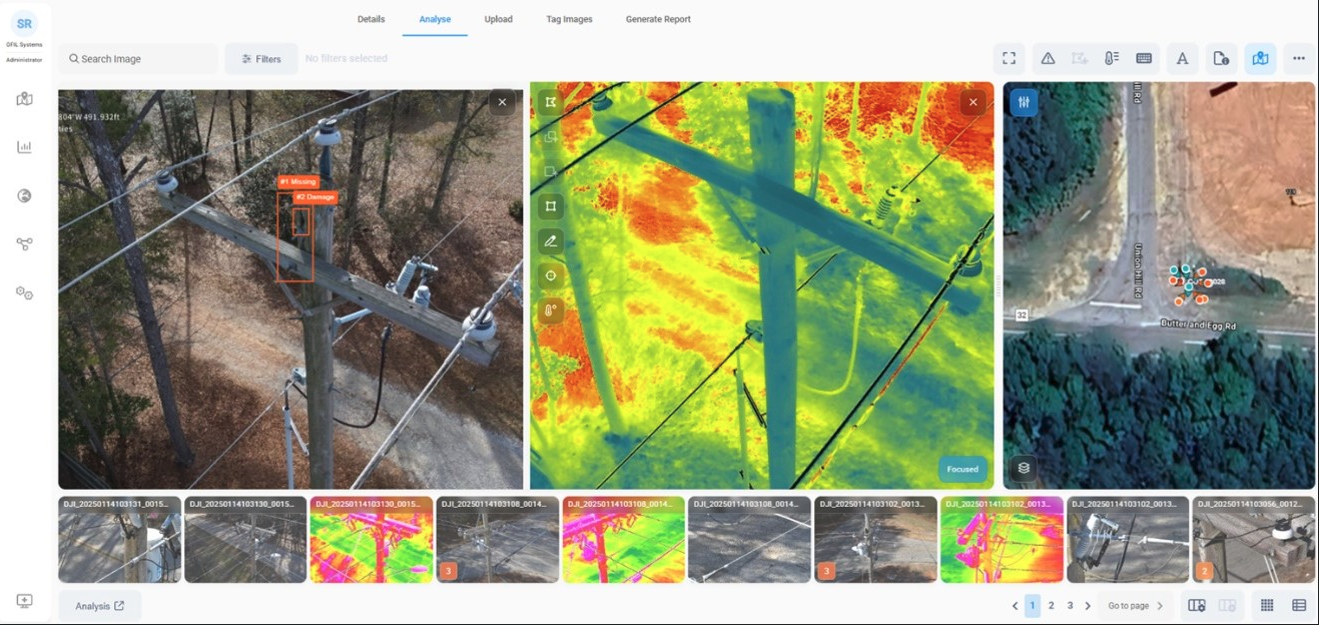
Increasingly, utilities are recognizing that combining multiple inspection technologies delivers a more complete understanding of asset condition than any single technology alone.
The ability to correlate findings across UV, thermal, and visual data sources significantly improves diagnostic confidence, reduces uncertainty, and helps prioritize maintenance actions more effectively.
Gridnostic inspection screen displaying findings from RGB and thermal imaging cameras
From Data Collection to Knowledge Preservation
The growing adoption of digital inspection technologies is creating another important benefit: preserving organizational knowledge.
Historically, inspection findings often remained within individual reports, spreadsheets, or the experience of specific personnel.
Today, digital asset management platforms can capture, organize, and standardize inspection data across entire utility networks.
When inspection results are stored consistently over time, utilities can create a permanent knowledge base that remains available even as experienced personnel retire.
This transforms asset management from being dependent on individual expertise to being supported by organizational intelligence.
From Inspection Data to Asset Intelligence
Utilities have never collected more inspection data than they do today.
The challenge is no longer gathering information.
The challenge is transforming information into actionable decisions.
Artificial intelligence and advanced analytics are increasingly helping utilities:
- Identify patterns across large inspection datasets
- Detect emerging defects earlier
- Prioritize assets based on risk
- Support less-experienced personnel with expert-level insights
- Improve consistency in asset condition assessments
Rather than replacing experienced engineers, these technologies help scale expertise across larger organizations and ensure that valuable knowledge remains available to future generations of utility professionals.
Reliability in the Next Decade
The future grid will undoubtedly include advanced technologies, AI applications, renewable generation, and expanded transmission infrastructure.
However, one reality remains unchanged: much of the electrical infrastructure supporting that future will consist of assets already in service today.
The challenge facing utilities is not simply managing aging equipment. It is managing aging equipment, increasing demand, growing system complexity, and a changing workforce – all at the same time.
Organizations that successfully combine condition-based maintenance, multi-sensor inspection, digital asset intelligence, and knowledge preservation strategies will be best positioned to maintain reliability in an increasingly demanding operating environment.
Because in the end, grid reliability is no longer determined solely by the condition of the assets, it is also determined by how effectively utilities can transform data and expertise into informed decisions.